Overview
Short answer: a good personalized cutting board gift balances a durable, food-safe material with an engraving that stays legible through years of normal kitchen use. The personalization is what makes the gift feel specific to the recipient, but the board still needs to function well as an everyday kitchen tool, or the personalization won't matter much once the novelty wears off.
Personalized cutting boards are a popular gift because they combine practicality with sentiment -- unlike many personalized gifts that end up as decorative-only items, a well-made board gets used regularly, which keeps the personal touch visible in day-to-day life rather than tucked away in a drawer.
This guide covers what to think about before ordering, the main material and engraving choices you'll encounter, and what to check on the listing to make sure the finished product will hold up over time.
Because these are made-to-order items, a personalized cutting board also requires a bit more planning than a typical gift -- you'll need to nail down exact text, confirm a proof if the seller offers one, and account for a longer lead time than an off-the-shelf item, all of which this guide addresses in more detail below.
Personalized boards also work well across a wide range of occasions -- weddings, housewarmings, anniversaries, and holidays all commonly feature this kind of gift, since the format flexes easily from a simple name-only design to a more elaborate layout for a couple or a family. That flexibility is part of why this remains one of the most consistently popular personalized kitchen gift categories.
What to know before you buy
Start by deciding what the board is primarily for -- everyday chopping and food prep, or occasional serving and display use. A board intended for heavy daily use benefits from a more durable material and a deeper, more resilient engraving method, while a mostly decorative board has more flexibility in material choice.
Think about what text or design the recipient would actually want to see daily. A name or short phrase tends to age better than a very specific date or in-joke, which can feel dated after a few years even though the board itself may last much longer.
Consider the recipient's existing kitchen style too -- a rustic, dark wood board fits a different kitchen aesthetic than a light, modern one, and matching the board's look to their existing kitchen makes it more likely to get displayed and used regularly rather than stored away.
It's also worth thinking about who else might see or use the board. If it's a gift for a household rather than one specific person, consider a design that reads well to any user -- a family name or shared phrase -- rather than personalization tied to just one person's name.
Finally, think about whether the recipient already owns a cutting board they rely on daily. If so, position this gift as an upgrade or a second board for a different task (serving versus chopping, for example) rather than assuming it will fully replace their current one right away.
Material and engraving options
Hardwood boards. Dense hardwoods hold an engraving crisply and tend to be more durable under regular knife use than softer woods, making them a solid default choice for a board meant for everyday cooking.
Bamboo boards. Bamboo is a common, more budget-friendly option that also takes engraving well, though it can show wear slightly faster than denser hardwoods under heavy daily use.
Laser engraving vs. other methods. Laser engraving is the most common personalization method for wood boards and tends to produce a crisp, long-lasting result. Confirm with the seller which method they use, since deeper engravings generally hold up better over years of washing than shallow ones.
Board shape and size. Boards come in a range of shapes -- rectangular, paddle-style with a handle, or rounded -- and sizes. A larger board suits more serious daily cooking, while a smaller paddle-style board can double as a serving piece for cheese or bread.
See our personalized kitchen gifts hub for more personalization ideas beyond cutting boards, including engraved utensils and custom recipe-related gifts.
Border and edge details. Some boards include a juice groove around the edge, useful for anyone who cuts meat or juicy produce regularly, while others use a plain flat edge better suited to serving or lighter prep tasks -- worth matching to how the board will actually be used.
Browse our recommended products
Our featured picks refresh periodically. While we update them, our editorial guides can help you find the right gift.
See our guidesWhat to check before buying
Always confirm the exact spelling, font, and layout of any personalized text before finalizing an order -- most sellers offer a digital proof, and it's worth requesting one if it's not automatically included, since personalized items are usually not returnable once made.
If you're ordering as a surprise and can't confirm exact spelling directly with the recipient, double-check with a family member or close friend who would know, rather than guessing at spelling variations for a name.
Check food-safety and care instructions for the specific material -- most wood boards require hand washing and periodic oiling rather than dishwasher use, and following the seller's specific care guidance will extend the board's usable life considerably.
Confirm production and shipping timelines well in advance of the occasion, since custom items typically take longer to produce than in-stock products, and rushed personalized orders are more prone to errors.
It's also worth checking the seller's policy on correcting errors after the proof is approved. Mistakes caught before production are usually easy to fix; mistakes discovered after the board is made and shipped are often the buyer's responsibility, so a careful review at the proof stage is well worth the extra few minutes it takes.
Mistakes to avoid
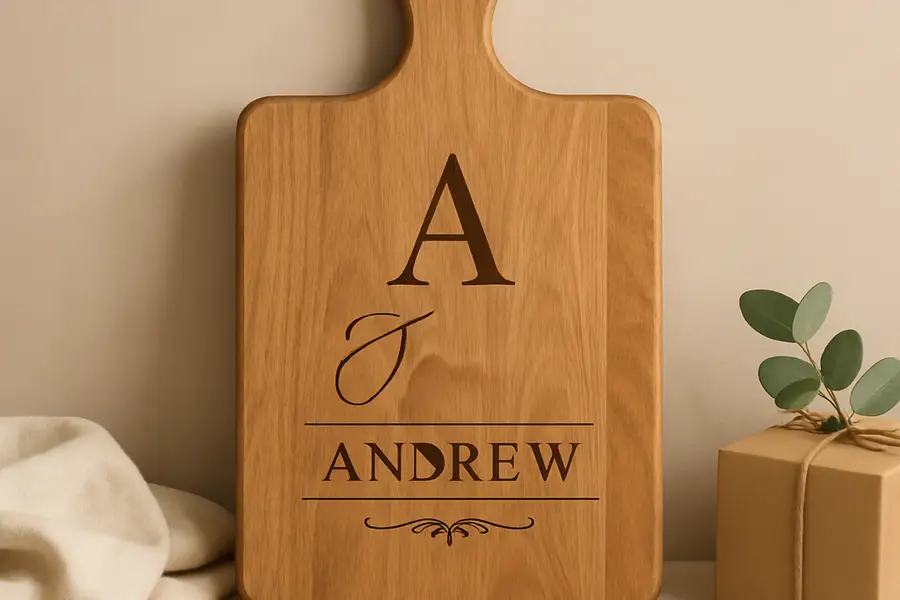
The most common mistake is ordering without reviewing a proof of the exact text and layout, which can lead to spelling errors or a design that looks different than expected once engraved -- a mistake that's difficult to correct after the fact on a custom item.
A second mistake is choosing a design so specific to one moment (an exact date, an inside joke) that it feels dated a few years later. A simpler, more timeless design tends to stay meaningful longer.
Finally, avoid ordering too close to the occasion. Custom items need production time, and a late order risks the gift arriving after the event it was meant for.
A less obvious mistake is choosing a material based only on appearance without considering how it will be cared for. A striking, unusual wood that requires frequent oiling can become a source of frustration for a recipient who wasn't expecting that level of upkeep, so it's worth mentioning basic care requirements if you're giving the board as a surprise.
Final thoughts
A good personalized cutting board balances a durable, food-safe material with a legible, well-proofed engraving and a design simple enough to stay meaningful for years. Order with enough lead time, request a proof, and choose a material suited to how often the board will actually be used.
For more personalized gift ideas, see our personalized kitchen gifts hub, or browse our full guides index for related buying guides.
Treat the personalization as the finishing touch on an otherwise genuinely useful kitchen tool, not a substitute for it -- a board that's both well-made and thoughtfully engraved is far more likely to stay in daily use than one chosen for its personalization alone.