Overview
Short answer: a good baking gift basket pairs one or two useful tools with baking-friendly pantry staples, and is matched to the recipient's current baking habits rather than an idealized version of "someone who bakes." A basket built for an experienced bread baker looks very different from one built for someone who bakes cookies a few times a year, and knowing which one you're shopping for is the most important decision you'll make.
Baking is a popular gifting theme because it's tactile and project-based -- unlike many kitchen gifts, a baking basket often gives the recipient something to actually do, not just something to own. This guide covers how to think about skill level, several basket ideas organized by that skill level, and what to check before buying either a pre-made basket or building your own.
Throughout, keep in mind that baking gifts split fairly cleanly into "tools" (rolling pins, measuring sets, pans) and "consumables" (flours, mixes, flavorings, spices). The best baskets usually combine a little of both, since a tool-only basket can feel impersonal and a consumables-only basket doesn't leave anything lasting behind.
It also helps to remember that baking, more than many other kitchen activities, tends to be seasonal for a lot of home cooks. Interest often spikes around the holidays and cools off the rest of the year, so a baking basket given in late fall or winter may land differently than the same basket given in the middle of summer. That doesn't mean baking gifts only work seasonally -- it just means it's worth thinking about timing alongside theme.
What to know before you buy
Start by identifying what the recipient already bakes regularly. Someone who bakes bread weekly has different needs than someone who bakes cookies around the holidays, and a basket built for the wrong category will duplicate tools they already own or introduce ingredients they have no immediate use for.
Consider kitchen equipment they already have. A basket built around a stand mixer attachment assumes they own a compatible mixer -- if you're not sure, choose tools that work independently of any specific appliance, like a bench scraper, a rolling pin, or a set of measuring cups.
Think about how much time baking actually takes in their routine. A basket built around a multi-day bread-proofing project is a wonderful gift for someone who has that kind of time, but a poor match for someone who bakes in short bursts between other responsibilities. When in doubt, favor simpler, faster baking projects over elaborate ones.
It's also worth thinking about whether the recipient bakes primarily for themselves or for sharing with others. Someone who bakes to share tends to appreciate baskets that yield a larger batch or a more shareable result, while a solo baker may prefer smaller-batch tools and ingredients that don't go to waste.
Finally, consider how the recipient prefers to learn something new. Some bakers enjoy following a written recipe closely, while others prefer to experiment loosely with a new ingredient. A basket built around a rigid, multi-step process is a better match for the former, while a basket of flexible ingredients suits the latter -- getting this wrong doesn't ruin the gift, but it can mean the basket takes longer to get used.
Basket ideas by skill level
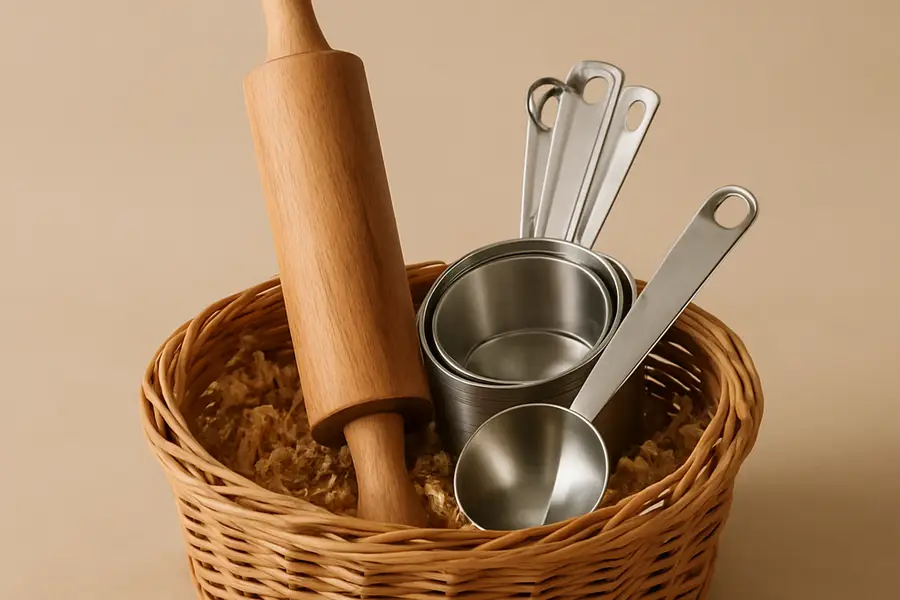
Beginner baskets. For someone just getting into baking, focus on core tools -- a good rolling pin, a set of measuring cups and spoons, and a mixing bowl -- paired with a simple, well-tested recipe or mix. Avoid highly specialized tools at this stage, since a beginner is more likely to use a few versatile items well than a dozen single-purpose gadgets.
Intermediate baskets. For someone who bakes semi-regularly, consider a basket built around a specific category they enjoy -- a cookie-decorating basket, a pie-baking basket with a rolling pin and pie weights, or a bread-baking basket with a bench scraper and proofing basket. These baskets work well because they deepen an existing interest rather than introducing a brand-new one.
Advanced baskets. For an experienced baker, a themed ingredient basket -- specialty flours, flavorings, or a regional baking tradition they haven't explored -- often lands better than another tool, since experienced bakers tend to already have the core equipment they need. See our baking gifts hub for more ideas across this range.
Holiday and seasonal baskets. A cookie-exchange basket built around the holiday season, or a basket themed around a specific seasonal ingredient, gives the basket a natural occasion and timeline, which can make it feel more intentional than a baking basket with no specific reason behind it.
Regional baking baskets. A basket built around a specific regional baking tradition -- Southern-style biscuits, Nordic-style breads, or a particular pastry style -- can be a good match for a baker who enjoys exploring new techniques rather than repeating familiar ones. This works especially well as a gift once you already know the recipient enjoys baking as a general hobby, since it gives them a specific direction to explore next.
Browse our recommended products
Our featured picks refresh periodically. While we update them, our editorial guides can help you find the right gift.
See our guidesWhat to check before buying
Before ordering, check the exact material of any included tools -- baking tools vary in material (wood, silicone, metal) and that material affects both durability and oven safety, so read the listing rather than assuming from a photo.
For consumable baking ingredients, check expiration dates and any relevant allergen or ingredient information directly on the seller's listing -- always confirm this with the seller or packaging rather than assuming based on similar products, since ingredients and sourcing can vary between listings that otherwise look similar.
If the basket includes a recipe or instructions, check that it matches the recipient's equipment -- a recipe written for a stand mixer isn't very useful to someone who only owns hand tools, for example.
It's worth double-checking the seller's return or exchange policy for tool-based baskets, especially if any item has a size or fit consideration (like a pan size or a rolling pin length). A quick check now avoids a frustrating exchange process later if something doesn't match the recipient's existing equipment.
Mistakes to avoid
The most common mistake is buying a highly specialized baking tool for someone who doesn't yet bake regularly. Specialty tools are best given once a specific interest is already established, not as an introduction to baking.
A second mistake is overloading a basket with perishable ingredients that won't be used before they expire. Match quantity to how often the person actually bakes, not to how full you want the basket to look.
Finally, avoid assuming every baker wants the same category of baking. Bread, pastry, and cookie baking are fairly distinct skill sets, and a basket built for the wrong one can feel like a mismatch even if the overall "baking" theme is correct.
A related mistake is choosing tools primarily because they look good in photos rather than because they're genuinely easy to use and clean. A beautiful but awkward tool tends to get used once and then set aside, while a plainer, well-designed one earns a permanent place in the kitchen.
Final thoughts
A well-matched baking gift basket starts with an honest read of the recipient's current baking habits and skill level, then builds a small, focused set of tools and ingredients around that specific category. Resist the urge to include everything baking-related you can find -- a smaller, better-matched basket beats a large, generic one.
See our full guides index for more baking-related guides as they publish, or browse the full baking gifts hub for more ideas and editorial picks.